Village Gods of the ancient South Indians
One of the most ancient practices employed in South Indian villages was the worship of their gods. Before the Aryan invasion, which probably took place in the second millennium BCE, the Dravidians, who were the original inhabitants with religious beliefs and customs similar to other primitive races. They believed the world to be peopled by a multitude of spirits, good and bad, who were the cause of unusual events, especially disease and disaster .They hoped that through their worship they could propitiate these innumerable spirits . Every village was seen to be under the protection of one spirit or the other, and this spirit was also its guardian deity.
Where the family developed into a clan, and the clan into a tribe, and the tribe into a nation, and the nation into a conquering empire, the god of the family naturally developed into an imperial deity. Very similar to the ancient civilizations in Nineveh, Babylon and Egypt where the agricultural communes gradually developed into nations.
In ancient India, before the Aryan invasion, there were only agricultural or pastoral communities. It was not until the northern parts of India had been conquered and the Brahminic influence spread to the southern parts that there was a spurt in philosophic thought
The problem of the universe did not interest the simple Dravidian folk. They only looked for an explanation of the facts and troubles of village life. The lack of water for their crops, disease which afflicted them and their children were for example paramount in their thinking.
Their religion, therefore, did not advance beyond animism and belief in village deities.
Later on, after the Aryans had overrun a large part of India, and the Brahmins had established their ascendancy as a priestly caste, the old Dravidian cults were influenced by the "so called" superior religion of the Aryans. The Amman (female god) - loosely translated as mother by the Dravidians was gradually transformed into Parvati,Saraswathi and Lakshmi - wives of Siva , Brahma and Vishnu - the major Gods of the Brahminic Hindu pantheon.
In almost every town and village in south you may see a shrine or symbol of the kaval-deivam (Guardian of the village) or kula-deivam (family deity), and in every village the Kaval-deivam is periodically worshiped and propitiated.
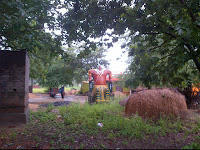
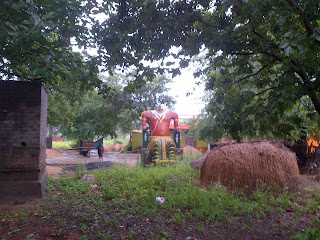
As a rule this shrine is far less imposing than the Brahmanical temples in the neighborhood ; very often it is nothing more than a small brick building three are four feet high, or a small enclosure with a few rough stones in the centre. Sometimes there is no shrine at all.
Yet, when calamity overtakes the village, when disease or water scarcity makes its appearance, it is to the village deity that the whole body of the villagers turn for protection. Siva and Vishnu may be the more dignified beings, but the village deity or Amman is regarded as a more present help in trouble, and is more intimately concerned with the happiness and prosperity of the villagers.
Siva and Vishnu represent forces of nature. While Siva symbolizes the power of destruction and the idea of life through death, Vishnu symbolizes the power of preservation and the idea of salvation. However, the village deities took care of only the village. People turned to them when there were epidemics or disease struck their cattle or there was a scarcity of water.
Interestingly, village deities, with very few exceptions, are female.
In contrast, the principal deities of the Hindu Pantheon - Siva, Brahma and Vishnu, are male. Their wives, it is true, play an important part in Hindu religious life but, by and large, the male deities are predominant and the female deities play a subordinate role.
It is possible that this is due to the fact that the Aryan deities were the gods of a race of warriors, whereas the Dravidian deities were the goddesses of an agricultural people. All over the world, the gods of war are mostly male, while the agricultural deities are, for the most part, female ; and this naturally arises from the fact that war is the business of men, whereas, among the Dravidians the cultivation of the fields was largely left to the women, and also from the fact that the idea of fertility is naturally connected with the female.
All over Southern India, therefore, the village deities are almost exclusively female. Most of them have male attendants, who are supposed to guard the shrines and carry out the commands of the goddesses; but their place is distinctly subordinate and almost servile.
The compound of his shrine is generally crowded with clay figures of horses, great and small, on which he is supposed to ride round the village in the watches of the night,to keep off evil spirits.
The Female God is referred to as Amman. The Amman has different names - Kaliamman, Kateriamman, Angalamman or Karumariamman and thousands of other names Each of them is worshiped for different reasons. For example, Karumariamman keeps away disease, while Kateriamman protects the village from evil spirits. They might not paint a pretty picture, but to the believers they serve a purpose.
With thanks to Henry Whitehead.
Where the family developed into a clan, and the clan into a tribe, and the tribe into a nation, and the nation into a conquering empire, the god of the family naturally developed into an imperial deity. Very similar to the ancient civilizations in Nineveh, Babylon and Egypt where the agricultural communes gradually developed into nations.
In ancient India, before the Aryan invasion, there were only agricultural or pastoral communities. It was not until the northern parts of India had been conquered and the Brahminic influence spread to the southern parts that there was a spurt in philosophic thought
The problem of the universe did not interest the simple Dravidian folk. They only looked for an explanation of the facts and troubles of village life. The lack of water for their crops, disease which afflicted them and their children were for example paramount in their thinking.
Their religion, therefore, did not advance beyond animism and belief in village deities.
Later on, after the Aryans had overrun a large part of India, and the Brahmins had established their ascendancy as a priestly caste, the old Dravidian cults were influenced by the "so called" superior religion of the Aryans. The Amman (female god) - loosely translated as mother by the Dravidians was gradually transformed into Parvati,Saraswathi and Lakshmi - wives of Siva , Brahma and Vishnu - the major Gods of the Brahminic Hindu pantheon.
In almost every town and village in south you may see a shrine or symbol of the kaval-deivam (Guardian of the village) or kula-deivam (family deity), and in every village the Kaval-deivam is periodically worshiped and propitiated.
As a rule this shrine is far less imposing than the Brahmanical temples in the neighborhood ; very often it is nothing more than a small brick building three are four feet high, or a small enclosure with a few rough stones in the centre. Sometimes there is no shrine at all.
Yet, when calamity overtakes the village, when disease or water scarcity makes its appearance, it is to the village deity that the whole body of the villagers turn for protection. Siva and Vishnu may be the more dignified beings, but the village deity or Amman is regarded as a more present help in trouble, and is more intimately concerned with the happiness and prosperity of the villagers.
Siva and Vishnu represent forces of nature. While Siva symbolizes the power of destruction and the idea of life through death, Vishnu symbolizes the power of preservation and the idea of salvation. However, the village deities took care of only the village. People turned to them when there were epidemics or disease struck their cattle or there was a scarcity of water.
Interestingly, village deities, with very few exceptions, are female.
In contrast, the principal deities of the Hindu Pantheon - Siva, Brahma and Vishnu, are male. Their wives, it is true, play an important part in Hindu religious life but, by and large, the male deities are predominant and the female deities play a subordinate role.
It is possible that this is due to the fact that the Aryan deities were the gods of a race of warriors, whereas the Dravidian deities were the goddesses of an agricultural people. All over the world, the gods of war are mostly male, while the agricultural deities are, for the most part, female ; and this naturally arises from the fact that war is the business of men, whereas, among the Dravidians the cultivation of the fields was largely left to the women, and also from the fact that the idea of fertility is naturally connected with the female.
All over Southern India, therefore, the village deities are almost exclusively female. Most of them have male attendants, who are supposed to guard the shrines and carry out the commands of the goddesses; but their place is distinctly subordinate and almost servile.
The compound of his shrine is generally crowded with clay figures of horses, great and small, on which he is supposed to ride round the village in the watches of the night,to keep off evil spirits.
The Female God is referred to as Amman. The Amman has different names - Kaliamman, Kateriamman, Angalamman or Karumariamman and thousands of other names Each of them is worshiped for different reasons. For example, Karumariamman keeps away disease, while Kateriamman protects the village from evil spirits. They might not paint a pretty picture, but to the believers they serve a purpose.
With thanks to Henry Whitehead.
Comments
Post a Comment