Different Gods 2
I have been observing that there are 2 different kinds of headless Statues.
 |
| Koothandavar Cult statue |
Notice the difference. This one has both feet planted firmly on the ground. That belongs to the Koothandavar Cult - the history I wrote about in my earlier blog http://sridhardoss.blogspot.in/2012/12/different-gods.html
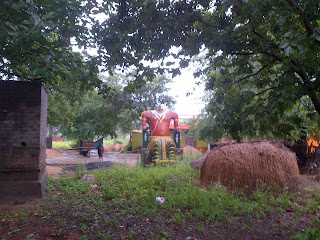
 |
| Draupadi cult statue |
Draupadiamman as she is called is peculiar to Tamil Nadu and also in some parts of Karnataka.The major difference between the Aravan and Draupadi cults are that there is no wedding ceremonies with Hijras or Alis. Men do not wear women's clothing as in the Koothandavar belief.
Here the major focus is on the sacrifice. Remember Iravan asked for two boons. One was that he wanted to get married before his sacrifice or Kalaballi (sacrifice in a battlefield) as it is known in Tamil. The second was that he wanted to kill as many Kauravas as possible and even if he died he wanted to watch the rest of the war.There are contradictory accounts to this but suffice it to say that the Draupadi cult believe that Iravan wanted to watch the entire war from beginning to end.
History or myth
Dhuryodhana was first off the mark. He knew that if a Kalaballi was performed to propitiate Goddess Kali , winning the war was a cinch. He went to Sahadeva (one of the Pandava brothers known to be a master astrologer). Sahadeva told him that if a kalaballi was performed in the day of the new moon - victory was guaranteed. D immediately approached Iravan to be the sacrificial lamb and the innocent he was - he agreed!.
New moon was slated to be in the next night.
Now comes in the greatest manipulator of all time- Krishna. He knows that if D's plan succeeds, the Pandavas are history. He parleys with Surya (the sun God ) and Chandra (moon ) and tricks them to coordinate themselves so that the new moon is that night itself.
Now there is a twist in the tale. There are four people who are qualified to be sacrificed. Shalya - who is in the Kaurava camp, Arjuna , Krishna and poor Iravan. Obviously Arjuna could not be sacrificed and Krishna - hell no.Krishna quickly persuades Iravan that he should be the one Naive and innocent Iravan agrees and the rituals for the kalaballi are made ready.
Innocent he might be but reality checks in, Iravan smartly puts in his conditions and one of that is that that he should be able to see the war for which he is sacrificing himself. Of course,Krishna agrees. He assures Iravan that even after his death , he will make sure that his head will be able to see the Mahabharata war in its entirety. The Pandavas quicky agree that Iravan is the one. Draupadi, her maternal feelings aroused,disagrees. She puts up a big fight but is finally over-ruled by Yudishtara.
The Kalaballi is performed that day itself.
Krishna, true to his word arranges for Iravan's head to be placed on a pole from which he can watch the battlefield.
Maybe the fact that Draupadi was so against Iravan being the sacrificial goat has spawned a cult in her name.
Tamils call this festival Pattukulam. or Aravan Kalaballi.
There are Therukoothus (street plays) which are performed extolling the war. Every day, different plays are performed depicting different scenes of the war, on the streets of the village. The head of Iravan is put on the headless statue and this is paraded around the village on the first day.
That evening there is a huge ceremony culminating with the priest symbolically cutting off the head of the statue. A pumpkin is used as the head and cut into 32 pieces - the 32 parts of the body which Iravan sacrifices to Kali.
In ancient times it is said that there were human sacrifices to please the Goddess Kali .Now buffaloes,sheep or chicken are used. The blood is mixed with rice and offered to Iravan. It is said that the rice mixed with the blood is thrown at the face of Iravan. The belief is that eating this rice will make the childless pregnant.
The last day actors re-enact Draupadi's angst and sadness at the death of so many and in particular.
Very interestingly there are similar stories in different parts of India. In Andhra Pradesh they worship Barabika. In Rajasthan he is known as Khatushyamji.
 |
| Khatushyamji |
The story is nearly the same but with a twist in the characters.
Here Barabika is the grandson of Bhima. More in my next blog.

very interesting
ReplyDeleteThis is super interesting! Looking forward to more...
ReplyDelete